Virtual Machines &
Workloads Integration
Expanding a cybersecurity product into an entirely new market — virtualised infrastructure — after a major acquisition. New personas, new terminology, two data streams, and a compressed timeline between two companies with very different ways of working.
Project Snapshot
- Create a Workloads section inside Inventory without disrupting existing Endpoints users
- Design two inventory pages for VMs with and without sensors, each with appropriate data models
- Design a first-ever automated sensor install flow — replacing a manual command-prompt process
- Define new personas for virtualisation/IT admin audiences
- Ship on schedule to meet cross-company engineering dependencies
Shipped on schedule. The security business unit expanded into a new market. User testing validated core flows and the architecture enabled faster Container and Cloud integrations that followed.
Research & Insights
The biggest research challenge on this project wasn't conducting studies — it was learning the domain fast enough to design for it. Virtualisation has its own deep technical vocabulary: hypervisors, VMware Tools versions, sensor eligibility, agentless vs agent-based protection. I had to understand what these meant for users before I could design anything meaningful.
The existing CB personas were security analysts and IT admins managing physical endpoints. Workloads introduced a new persona: the virtualisation admin or vSphere operator — someone who manages the VM infrastructure itself and may have different tools, workflows, and mental models from the security-first CB users.
Wireflows
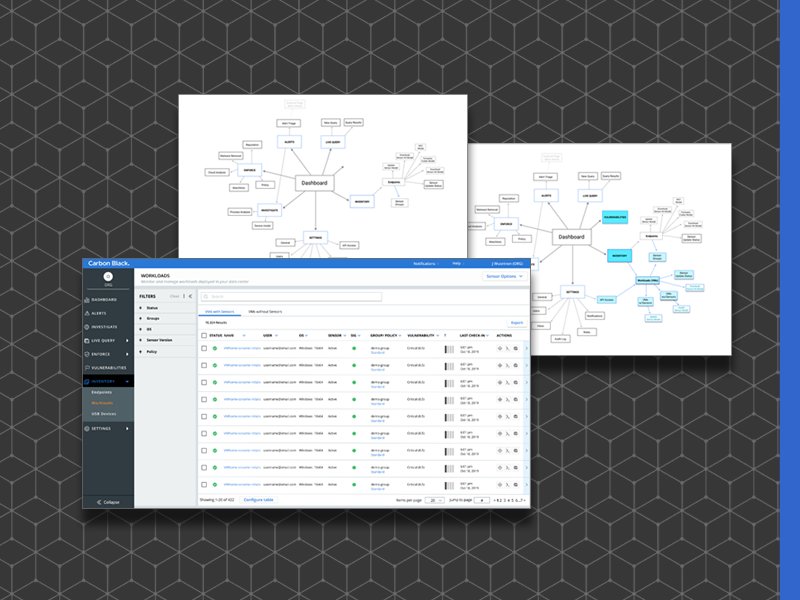
Wireflows documented the full interaction sequences for the two most complex flows: the workloads inventory navigation, and the appliance setup — these were mission critical to get design and development marching forward together.
Wireframes
The information architecture went through five iterations as engineering constraints clarified what was actually buildable. The gallery below shows the full evolution — from the original Endpoints-only structure through to the final separate-page approach that shipped.
With the IA resolved, wireframes focused on the two core inventory pages and the sensor installation flow. The VMs without Sensors page was the most novel design challenge — it needed to clearly communicate why data was absent and what action would fix it.
System Maps
The system maps show the before/after — from an Endpoints-only inventory to a scalable architecture that accommodated Workloads and laid the foundation for Containers and Public Cloud — integrations I also worked on.
Design Decisions
The central design challenge was integrating a new technical domain into an existing product without disrupting the mental models of current users — while making the new features clear and discoverable for the virtualisation admin audience.
Final Design
The final designs shipped two new inventory pages and a sensor installation flow — all integrated into the existing CB product navigation without disrupting the Endpoints experience. The visual design followed the established CB component system with workloads-specific additions for eligibility and install status.